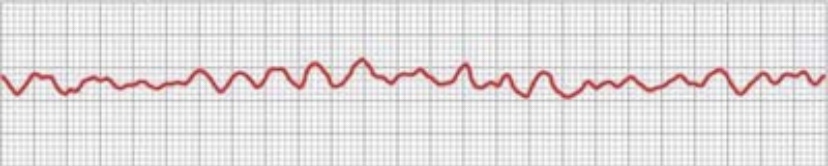
Ventricular fibrillation is when the ventricles beat at an abnormally high rate. It occurs due to chaotic impulses in the ventricles. While some portions of the ventricles are being stimulated and contracted, other portions are unstimulated and relaxed. Thus, overall ventricular function is impaired, and the the heart cannot pump blood effectively. This ineffective pumping of blood results in reduced blood flow to all parts of the body, especially detrimental to the brain (lack of blood flow to the brain even for 4-5 seconds causes unconsciousness, and if continues longer can cause permanent brain damage). The ECG in ventricular fibrillation is bizarre and shows no particular pattern.
Treatment
- Cardiopulmonary resuscitation (CPR)
- Placing implantable cardioverter-defibrillator (ICD) in at-risk patients
In CPR, the heart is pumped by proper rhythmical thrusts of the hand. When enough blood has pumped through the aorta and coronary circulation restored, defibrillation, by passing brief high-voltage currents to the chest, can be carried out.
ICDs are devices that can sense the abnormal current circuits in the ventricles and can subsequently send large jolts of current. These days, ICDs can be placed even subcutaneously.
The rationale for passing brief large jolts of current during ventricular fibrillation is that the large jolt of current sends all of the ventricular muscle into refractoriness, following which a normal impulse from the SA node can take over.
 Physiology Notes
Leave a comment