Introduction
Proteins are an immensely vital component of cellular structures. Hence, the way they are regulated – their synthesis, degradation and modification – is very crucial to appropriate bodily function. Degradation of proteins is carried out in lysosomes but also in proteasomes, which are intracellular multi-protein complexes.
Structure
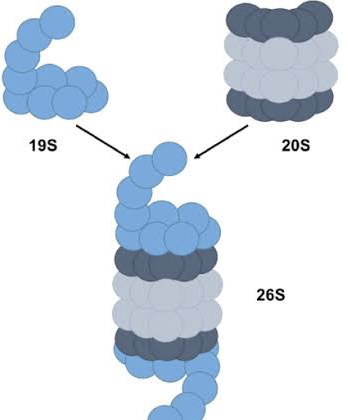
Proteasomes consist of a middle barrel shaped subunit (20S or 26S) covered by caps (19S) at its ends. The 20S or 26S subunit consists of outer and inner rings.
Function
Proteins which are to be degraded by the proteasomes are first ubiquinated. Following it, they enter the 20S or 26S subunit, where they undergo a ‘death of thousand cuts’.
Therapeutic significance
Some drugs can inhibit proteasomes. They increase the levels of IK-B, subsequently reducing the quantity of NF-KB, a protein necessary for cellular survival. With decreased NF-KB, the cells proceed towards apoptosis. Hence, these drugs are effective against cancers.
 Physiology Notes
Leave a comment